EV Battery Degradation: How Much Does an EV Battery Degrade and How to Extend Its Life?
.webp)
One of the most common questions asked by potential buyers of an electric vehicle (EV) prior to their purchase concerns EV battery degradation. The majority of the owners are usually concerned with how long the battery will last them, how much range they will lose as the battery ages, and if the battery is expected to be replaced after a few years. Degradation is certainly a reality. However, degradation does not imply that an EV battery stops working after a given number of years. Much like the battery in a smartphone or laptop, an EV battery will gradually lose some of its ability to store energy.
Research into the lifespan of EV batteries also finds that a number of factors, including battery chemistry, operating temperature, charging behaviour, usage patterns and the time the battery spends at extreme states of charge, play important roles in determining the rate at which an EV battery degrades. For the EV owner, the key question, therefore, is not whether degradation occurs but at what rate it occurs and what can be done to slow it down. In the article, we take a closer look at EV battery degradation.
What Is EV Battery Degradation?
EV battery degradation refers to the gradual reduction in a battery's ability to store and deliver energy compared with when it was new. For example, consider an EV with a 50 kWh usable battery capacity when new. If this capacity eventually declines to 45 kWh, the battery has lost some of its original capacity. This is not to say that the battery has become worthless. The vehicle will be able to continue to operate, but its driving range may become limited.
Battery degradation is often measured in terms of State of Health (SOH). A battery with an SOH of 100% is essentially said to have retained its original usable capacity, while a battery at 90% SOH has lost some of its usable capacity. It is important to remember that degradation is generally a gradual process. The rate of degradation varies from one EV to another, so there is no single percentage that applies to every electric car and electric scooter.
How Does an EV Battery Degrade?
.webp)
EV battery degradation generally stems from two broad processes: calendar ageing and cycle ageing.
Calendar ageing
Calendar ageing simply occurs as a result of time passing. Even if an EV is parked and not being driven, chemical reactions within the battery continue to occur, slowly reducing the battery's ability to store energy. The rate can be affected by a number of variables, including:
- Battery temperature
- The battery's state of charge while parked
- Battery chemistry
- Storage conditions
- And overall battery design
This means an EV that is driven for relatively little time can experience some degradation over several years.
Cycle ageing
Cycle ageing is associated with charging and discharging the battery. Every time an EV uses energy and replenishes it, the battery goes through electrochemical changes that wear it down over time. It is important to note, however, that one charging session does not necessarily count as one full cycle.
For example, using 25% of the battery today and another 25% tomorrow represents a much smaller energy throughput than repeatedly running the battery down from full capacity to almost empty. Battery manufacturers therefore consider the amount of energy passing through the battery, operating conditions and other factors when assessing battery life.
What Causes EV Battery Degradation?
.webp)
There are a number of factors that can cause an EV battery to degrade. Some lie with the EV manufacturer, while others depend on how the owner uses the EV. Here are some of them:
1. High temperatures
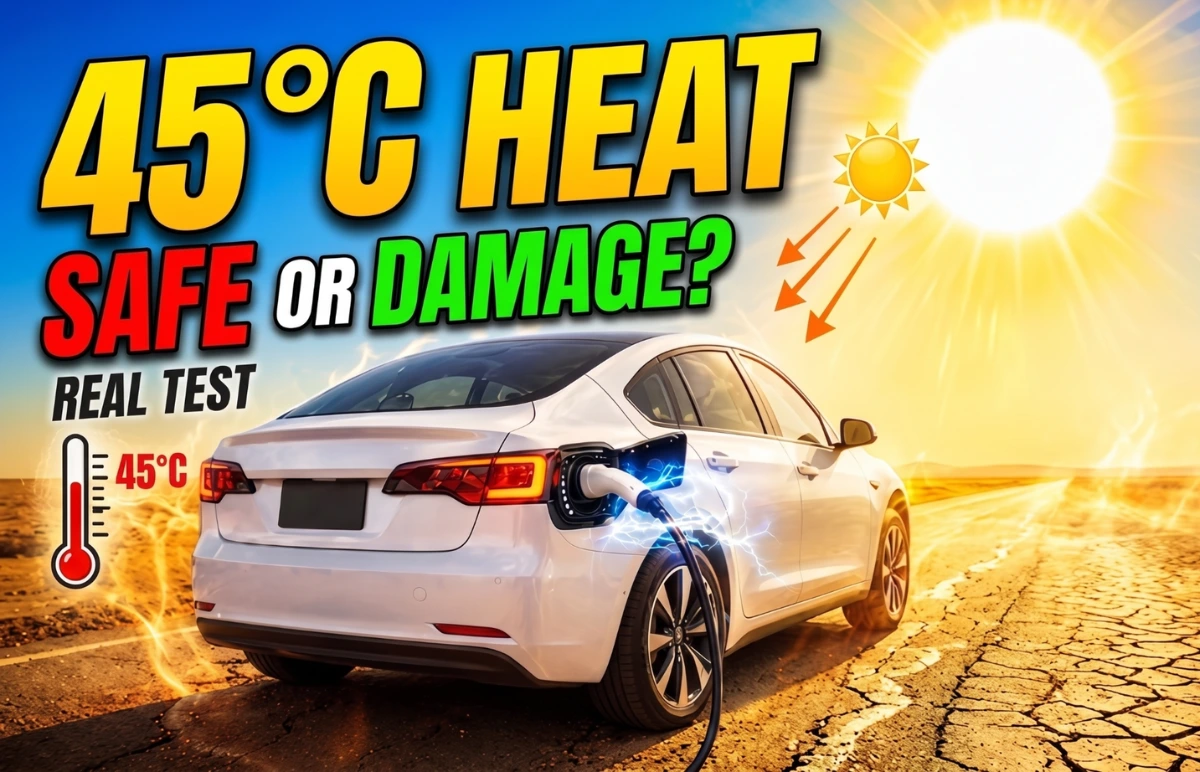
Temperature is one of the most important factors affecting lithium-ion battery ageing. Battery packs are therefore equipped with thermal-management systems in many modern EVs to ensure that the cells remain within an appropriate operating range. High battery temperatures can speed up the chemical reactions within cells, contributing to faster ageing. As a result, parking an EV in extremely hot weather for long periods, particularly with the battery at a high state of charge, is not ideal.
2. Keeping the battery at a very high charge level for long periods
Keeping the battery at a very high state of charge for long periods can also put additional stress on the battery. This does not necessarily mean that charging the EV to 100% is always harmful. Some vehicles are designed to reach 100% when needed, and manufacturers may recommend periodic full charging for battery-management or range-estimation purposes.
3. Frequently allowing the battery to become extremely low
Frequently running the battery at very low states of charge can also put additional stress on the battery. Again, occasionally running the battery down to a low level is not the same as constantly doing so. Driving the EV to an extremely low charge level should be planned in advance, particularly for long journeys.
4. Frequent high-power DC fast charging
Fast charging is one of the most useful features of modern EVs, particularly over highways. However, high-power charging can generate additional heat and put additional demands on the battery. Research into EV battery degradation has found links between high charging loads, temperature and ageing, although the actual impact varies considerably depending on the battery, vehicle and thermal-management system.
5. Aggressive driving
Hard acceleration and sustained high-power driving can increase the electrical load on the battery. Repeated high-power operation can also generate more heat, particularly when combined with high ambient temperatures. An EV is designed to deliver strong acceleration, so occasional spirited driving is not inherently damaging.
6. Long-term storage
An EV that is left unused for a few weeks or months needs to be stored properly. Leaving the battery fully charged or almost empty for a prolonged period is generally less desirable than following the manufacturer's recommended storage charge level.
Also check: Top 5 Mistakes EV Owners Make That Kill Battery Life
How Much Range Does an EV Lose as the Battery Ages?
.webp)
There is no universal figure for how much range an EV will lose after five or ten years. The result depends on:
- Battery chemistry
- Pack size
- Vehicle design
- Climate
- Charging pattern
- Driving conditions
- Mileage
- Fast-charging frequency
- Battery-management system
As an example, if a new EV has a real-world range of 350 km and its usable battery capacity eventually falls by 10%, the theoretical equivalent range under similar conditions could also decline by roughly 10%. However, real-world range is affected by a number of other factors, including weather, speed, tyre pressure, traffic, air-conditioning use and driving style.
Therefore, a lower range reading does not necessarily prove that the battery has degraded significantly.
How to Check EV Battery Health?
.webp)
Battery health is not always as easy to measure as fuel efficiency. Some EV manufacturers provide battery-health information via the vehicle's display, mobile application or service diagnostics. Others may require an authorised service centre to perform a battery-health assessment. Owners should look for:
- State of Health: SOH is one of the most useful indicators since it seeks to show the battery's current condition relative to its original capacity.
- Usable battery capacity: Comparison of the amount of energy the battery can accept or deliver under controlled conditions can provide a better indication than simply looking at the displayed range.
- Changes in real-world range: If an EV that previously delivered a consistent range under similar driving conditions suddenly loses a significant amount of range, it may be worth having the battery inspected.
- Charging behaviour: Unexpectedly slow charging, repeated charging interruptions or unusual battery-temperature warnings should also be investigated, rather than assuming degradation.
What Are the Signs of EV Battery Degradation?
Battery degradation generally occurs gradually, so owners may not notice it immediately. Some possible indicators include:
Noticeably lower driving range under similar conditions
- More frequent charging than before
- A measurable reduction in battery State of Health
- Reduced usable battery capacity
- Increasingly noticeable range differences between similar driving conditions
- Battery-related warnings or abnormal charging behaviour
However, reduced range alone does not necessarily indicate battery degradation. For example, using the air conditioner more frequently, driving at higher speeds, carrying additional passengers or experiencing colder or hotter weather can all reduce the range without indicating a serious battery problem.
How to Increase EV Battery Life?
.webp)
There is no way to completely stop battery ageing, but owners can adopt habits that may help minimise unnecessary stress.
- Follow the manufacturer's recommended charging limit
Do not assume that keeping the battery at 100% all the time is the best approach simply because the vehicle allows it. Use the recommended everyday charging limit where applicable, and charge to 100% when the extra range is genuinely required or when the manufacturer recommends it. - Use AC charging for routine use
Home AC charging is often convenient for overnight charging and can reduce the need for frequent high-power DC charging. - Keep the vehicle cool when possible
Covered parking and avoiding unnecessary exposure to heat can be useful in hot climates. - Avoid extreme battery levels for long periods
Try not to leave the EV sitting at either an extremely high or extremely low state of charge for extended periods. - Drive smoothly
Normal, smooth driving reduces unnecessary high-power demand and can also improve efficiency. - Follow software and service updates
Battery management is increasingly controlled through software. Manufacturers may release updates that improve battery monitoring, charging behaviour or thermal management. Owners should therefore keep their EV's software and scheduled maintenance up to date.
Also check: 15 Electric Vehicle Myths and Facts in India 2026
Is EV Battery Replacement Expensive?
.webp)
Battery replacement can be expensive because the traction battery is one of the largest and most technologically complex components of an EV. However, the assumption that every EV will require a complete battery replacement after eight years is misleading. A battery can continue working after its warranty period, although with some reduction in capacity. Battery packs also contain multiple modules and many individual cells.
Depending on the fault, vehicle design and manufacturer's repair policy, the required service may not always involve replacing the entire pack. The exact cost of battery repair or replacement depends heavily on the vehicle, battery size, chemistry, availability of parts and manufacturer's service strategy. This is why buyers should check the battery warranty, coverage conditions and degradation threshold before purchasing an EV.
Also check: EV Battery Replacement Cost in India (2026)
What Does an EV Battery Warranty Cover?
.webp)
Battery warranties vary between manufacturers and models. They may specify a timeframe, maximum kilometres and, in some cases, a minimum guaranteed State of Health or capacity retention. For example, Hyundai India lists an 8-year/160,000-km battery warranty for certain EV-related offerings, while manufacturers across the industry have different warranty structures. Buyers should not assume that every EV has identical coverage. The warranty booklet for the specific model is the most important document to check. Pay attention to:
- Warranty duration
- Kilometre limit
- Minimum battery-capacity guarantee, if applicable
- Conditions for warranty claims
- Whether battery and motor warranties are separate
- Coverage for battery-management components
- Warranty transfer conditions for used vehicles
Does Fast Charging Damage an EV Battery?
.webp)
This is one of the most common EV battery questions. The simple answer is: fast charging can contribute to battery ageing, but modern EVs are designed to handle it. A vehicle's Battery Management System controls charging power based on factors such as battery temperature, state of charge and charging conditions. The charging rate also typically changes during a charging session.
An EV may accept high power at a lower state of charge and gradually reduce the charging power as the battery approaches a high state of charge. This is why charging from around 10% to 60% can be significantly faster than charging from 80% to 100%. For everyday use, home AC charging can reduce dependence on high-power DC charging. On road trips, however, fast charging remains an important part of EV ownership. The key is not to treat fast charging as something that must never be used. Instead, use it when its convenience matters.
Does Indian Heat Reduce EV Battery Life?
.webp)
India's climate makes thermal management particularly important for EVs. High ambient temperatures can increase battery temperatures, especially if an EV is parked outdoors, driven continuously in hot conditions or charged when the battery is already hot. Modern EVs use different thermal-management strategies depending on the model. Some vehicles use liquid cooling, while others use different methods of controlling battery temperature.
The battery-management system can also reduce the charging power or vehicle performance when temperatures move out of the preferred operating range. For owners, practical precautions include:
- Prefer shaded or covered parking during extreme heat.
- Avoid leaving the EV fully charged in direct sunlight for long periods.
- Allow the battery to cool when necessary before demanding maximum charging power.
- Follow the manufacturer's charging recommendations.
- Do not ignore battery-temperature warnings.
Thermal management is one of the reasons why battery technology cannot be judged solely on battery capacity. The software, cooling system, cell chemistry and overall pack design also affect long-term performance.
Should Battery Degradation Stop You From Buying an EV?
For most buyers, battery degradation should be considered as part of EV ownership rather than treated as a reason to automatically avoid electric vehicles. Modern EV batteries are supported by sophisticated battery-management systems, thermal controls and extensive warranty coverage. Battery lifespan also depends heavily on how the vehicle is operated. The more important question is whether the EV suits your daily usage.
If your daily travel is well within the vehicle's practical range, even some gradual capacity loss may not have a major effect on ownership. A vehicle that starts with significantly more range than your daily requirement can continue to meet your needs even as the battery ages. Used-EV buyers should pay particular attention to battery health since the condition of the battery can have a major impact on the vehicle's remaining range and value.
Final Verdict
EV battery degradation is unavoidable, but it is not necessarily a major problem for modern electric vehicle owners. Battery ageing occurs through a combination of calendar ageing and usage-related cycling. High temperatures, prolonged high states of charge, heavy battery loads and certain charging conditions can influence the rate of degradation. The good news is that EV owners can reduce unnecessary battery stress through sensible charging and driving habits. For everyday use, following the manufacturer's recommended charging limits, avoiding prolonged exposure to extreme temperatures, using AC charging when convenient and relying on DC fast charging when necessary are practical approaches.
.webp)